IIR Filter Design · Part 1 · 21:32
IIR Filter Design (Part 1): Tolerance Masks, Group Delay, All-Pass EQ & Pole-Zero Notch
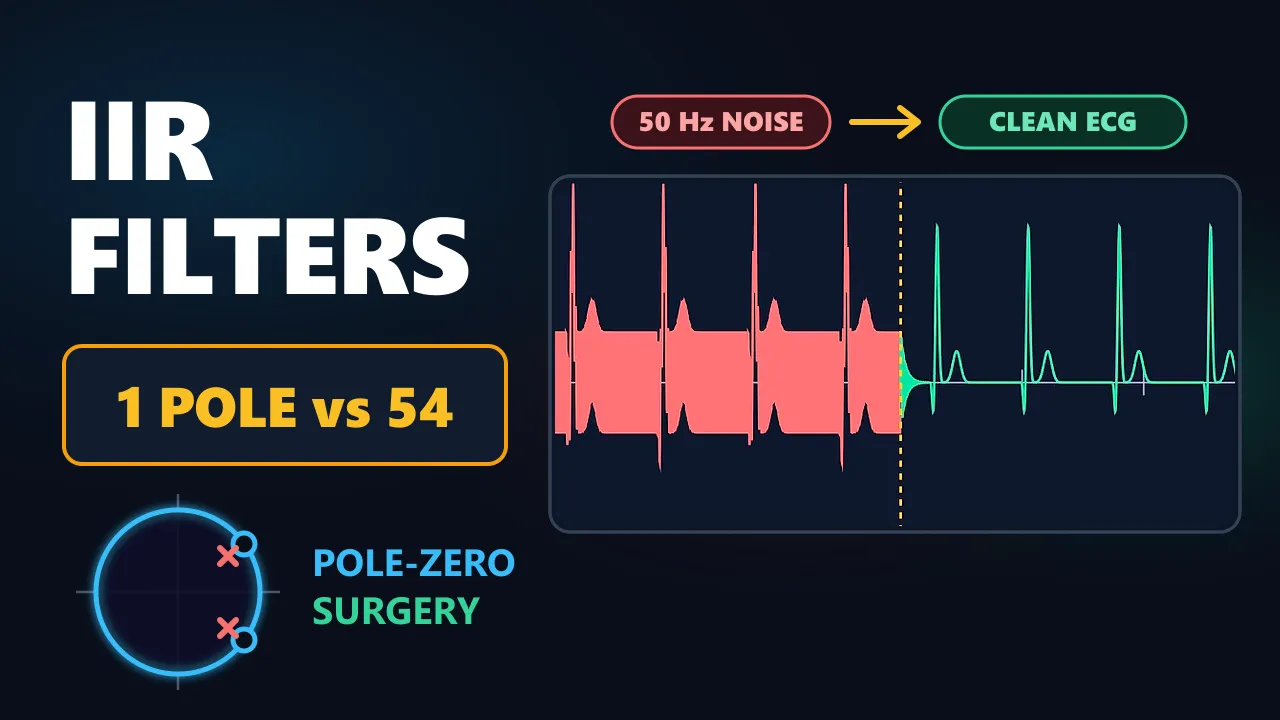
Why one recursive pole matches 54 moving-average taps, how to translate real ECG specs into a digital tolerance mask, group delay vs. sharpness trade-offs, all-pass phase equalisation, and hand-sculpting a surgical 50 Hz notch filter with a live audio demo.
Digital Signal Processing: From Sequences to Filters · Chapter 8, Sec. 8.1–8.2
youtube-nocookie.com) — no request is sent to YouTube until you press Play.Watch on YouTube ↗Interactive timeline
Chapters
Select any timestamp to jump straight to that moment in the lesson.
Key concepts
What you will learn
- Direct Form II biquad hardware behind scipy.signal.butter(2, 0.3)
- Why 1 recursive pole matches 54 moving-average taps in frequency selectivity
- Mapping physical ECG specs (Hz, dB) into a digital tolerance mask (ωp, ωs, ε, δs)
- Hardware showdown: 46-tap Kaiser FIR vs. Butterworth (12), Chebyshev I (6), and Elliptic (4)
- Group delay τg(ω) = −dθ/dω and flattening IIR delay with an all-pass equaliser
- Pythagoras 3-dB bandwidth rule BW ≈ 2(1 − r) and live 50 Hz ECG notch filter demo
Quick self-check
Check your understanding
You need a 50 Hz notch filter at fs = 500 Hz with a 3-dB bandwidth of 4 Hz. Using the geometric rule BW ≈ 2(1 − r), what pole angle ω₀ and backing pole radius r should you choose?
The digital notch angle is ω₀ = 2π(50/500) = π/5 rad/sample (36°). The 3-dB bandwidth is BW = 2π(4/500) = 0.0503 rad/sample. Solving 2(1 − r) = 0.0503 gives r = 1 − 0.0251 = 0.975.